

Successful debt collection starts with one fundamental requirement: reaching people in a way they are willing to engage with. Today, with multiple communication touchpoints (SMS, voice call, email, portal, live chat), 90% of consumers expect personalization and uniformity in communication across all channels.
Yet many debt buyers and lenders still operate through multiple channels in silos. Calls handled by one team, texts by another, emails triggered independently, with no shared context. The result is fragmented outreach, repeated explanations, frustrated consumers, and missed recovery opportunities.
Omnichannel communication strategy addresses this gap by coordinating outreach across channels within a single, shared context. With this personalized strategy, lenders, debt buyers, and collection agencies increase contact rates, reduce friction, and improve debt collection while adhering to compliance.
Let’s understand what omnichannel communication is, its benefits, and how Kompato AI lets you leverage this modern AI-powered technology to boost the liquidation rate and enhance your consumers’ experience.
What is an Omnichannel Communication Strategy?
Omnichannel communications means engaging with consumers in their debt collection journey through multiple connected channels (both digital and traditional) that are not blind to each other. Unlike multichannel communication, where each channel operates independently, omnichannel treats communication as one continuous conversation across all channels by preserving the context from past interactions.
The goal is to reduce friction and ensure that debtors don’t have to repeat themselves or switch between disconnected systems.
Imagine a company delays payment, and the owner clicks a payment-plan link in an email. When contacted by phone, the agent references that plan and schedules installments instead of re-negotiating from scratch. This kind of debtor experience is only possible through an omnichannel communication strategy.
Why Omnichannel Outperforms Traditional Debt Collection
Research shows that compared to 15 years ago, when the average consumer used just two touchpoints and only 7% engaged with more than four, today customers engage with an average of nearly six touchpoints, and 50% regularly employ more than four.
We have observed a diminishing success rate in call-and-collect operations. Traditional debt collection treats every outreach attempt as a standalone event, due to which both the collector and the consumer need to start the conversation from scratch each time. Omnichannel communications replaces this fragmented model with continuity and flexibility that improve debt collection.
| Feature | Traditional Collection | Omnichannel Collection |
| Approach | Process centric | Customer-centric |
| Channels | Siloed | Integrated |
| Data | Disjointed/Manual | Real-time & Unified |
| Customer Experience | High Friction | Low Friction/Self-Serve |
| Cost | High (Labor-intensive) | Lower (Automated/Efficient) |
| Effectiveness | Low | High |
Key Benefits of Omnichannel Communications in Debt Collection
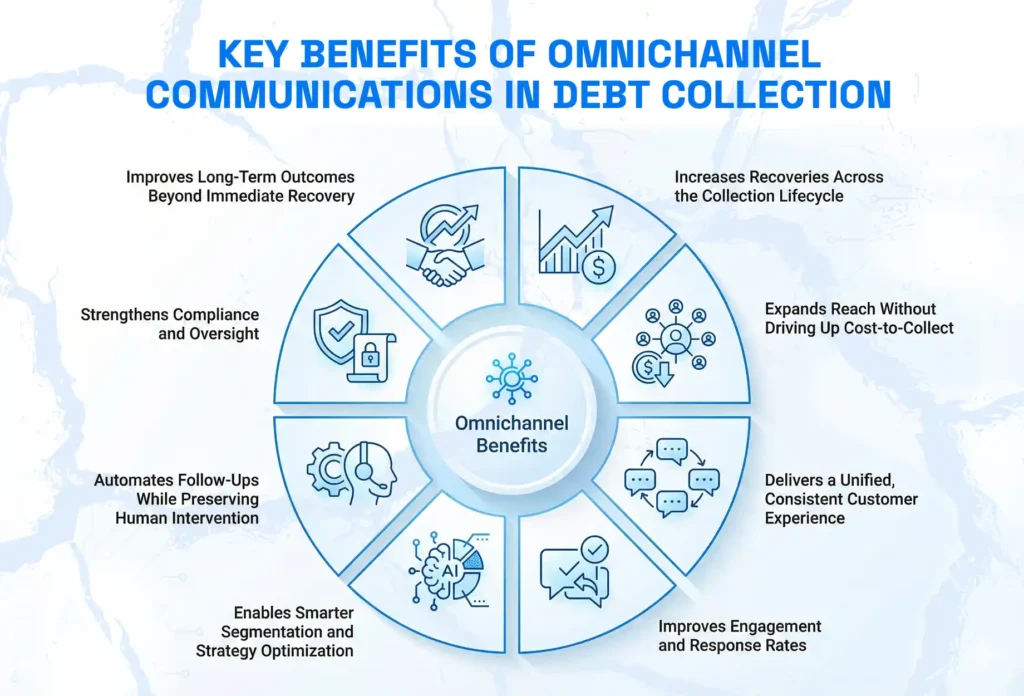
Increases Recoveries Across the Collection Lifecycle
Traditional operations concentrate effort in the early days (first 30-60 days), then reduce intensity. Omnichannel communication is one of the successful debt collection techniques to boost recovery rates as it keeps your consumers engaged from early delinquency through later stages while preserving the context from each stage. As a result, consumers re-engage faster, collection success rates increase up to 25%, and recovery timeframes are reduced by weeks.
Expands Reach Without Driving Up Cost-to-Collect
Traditional collections scale by adding agents and dialer capacity. Omnichannel communications augments high-cost manual phone calls and human agents with low-cost, automated digital channels that align with debtor preferences. AI agents reduce collection costs by 50% by handling routine inquiries and initial contacts, allowing human agents to focus on high-risk accounts that require careful judgment.
What we have observed is unlike traditional approaches, where human resources and cost scale linearly with rising delinquency, tools like Kompato AI handle spikes without a proportional increase in cost.
Delivers a Unified, Consistent Customer Experience
Omnichannel communications align the messaging, disclosures, and offers across every touchpoint. Interactions feel coordinated, respectful, and purposeful.
For example, a debtor who receives an email offering a three-month plan sees the same offer in the portal and hears it referenced during a call. This clarity and uniformity eliminate confusion and offer a consistent consumer experience.
Improves Engagement and Response Rates
According to McKinsey, 71 percent of consumers expect companies to deliver personalized interactions. And 76 percent get frustrated when this doesn’t happen.
Omnichannel communication strategy aligns outreach with consumers’ preferred channel and timing, which increases engagement rates by 282%. By providing multiple options, omnichannel communications empower debtors to choose what works best for them.
Enables Smarter Segmentation and Strategy Optimization
AI-powered commercial approach gathers interaction data from all channels in real-time and feeds segmentation models to apply dynamic and tailored outreach strategies in the future.
For instance, if a debtor consistently opens emails but ignores calls, the system automatically prioritizes digital-first outreach.
Automates Follow-Ups While Preserving Human Intervention
Automation handles consistency; humans handle complexity. Omnichannel communications automates debt collection processes like routine follow-ups (reminders, payment links) across digital channels. Leveraging AI in debt collection can detect when a situation requires human empathy or complex negotiation.
Imagine a debtor missed an installment, automated reminders trigger first. If non-response persists, the account is routed to a human agent who already sees prior attempts and deals with higher judgment and negotiation.
Strengthens Compliance and Oversight
An AI-powered omnichannel system is trained on all compliance rules through “compliance as a code” and enforces them in real-time across all communication channels. Centralized communication controls enforce contact limits, disclosures that reduce human error and audit risk.
Our tool, Kompato AI, scores every conversation automatically against 45 compliance checkpoints (FDCPA, TCPA, Reg F) and deterministically provides consistent coverage across 100% of interactions.
Improves Long-Term Outcomes Beyond Immediate Recovery
We’ve seen that respectful, coordinated engagement preserves relationships, especially for first-party lenders. Companies with extremely strong omnichannel customer engagement retain, on average 89% of their customers, compared to 33% for companies with weak omnichannel customer engagement.
How Omnichannel Debt Collection Works in Practice
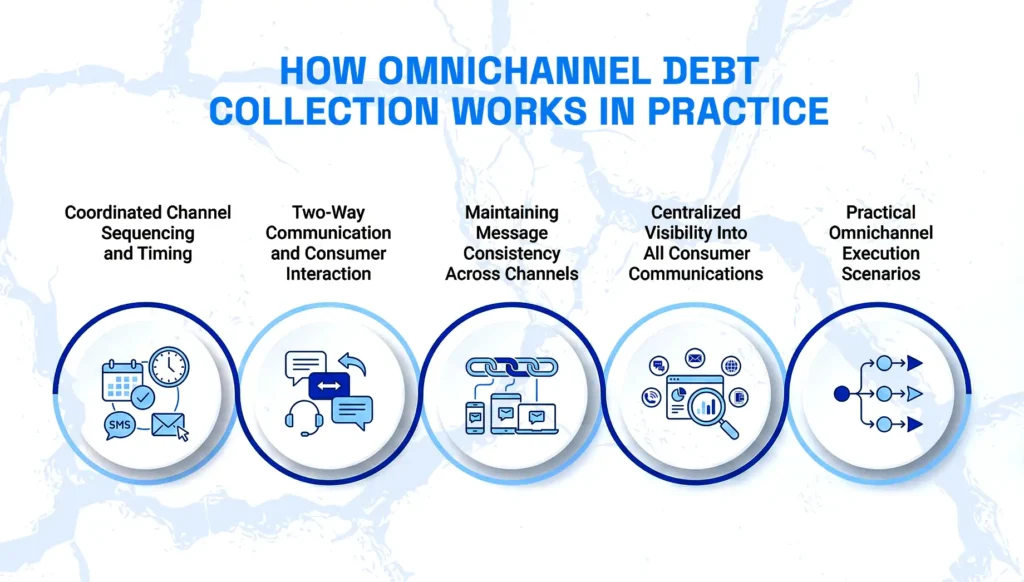
Omnichannel collections start with intentional sequencing, not random outreach. Channels and timings are triggered based on account age, past behavior, and response signals. Early delinquency may begin with low-friction SMS or email, followed by a call only if digital engagement stalls.
Two-Way Communication and Consumer Interaction
Rather than broadcasting a message, omnichannel communications works like a seamless, continuous conversation, which means consumers can reply to texts, ask questions via chat, click portal links, or speak with an agent, all within the same system. This changes the channel from one-directional outbound notification to conversational resolution on the consumer’s terms.
Maintaining Message Consistency Across Channels
Every channel is connected to the same source of truth for balance, disclosures, payment options, and account status. This prevents contradictory messaging that confuses consumers and creates disputes.
For example, if an email offers a 4-month installment plan, the portal, SMS follow-up, and agent call reference the exact same terms.
Centralized Visibility Into All Consumer Communications
Human agents and digital channels see a complete interaction timeline, including calls, texts, emails, portal activity, promises to pay, and disputes in one view, along with the outcomes. No switching systems or guessing context.
Practical Examples of Omnichannel Execution Across Common Scenarios
Debt collection operators need practical playbooks, not theory. From our years of experience in the debt collection industry, we recommend mapping each scenario to a specific client profile:
- Scenario 1: (risk-averse creditor): Start digital-only, use email/SMS to drive consumers to a portal where they can self-serve or grant consent for voice contact. Then layer in outbound voice only for consented consumers.
- Scenario 2 (third-party collection): Implement full omnichannel communications from day one. Email establishes awareness, SMS creates urgency, AI voice handles negotiation, and portal enables self-service payment at any time.
- Scenario 3 (high-balance accounts): Accelerate to human agent involvement based on account complexity, balance, and propensity to pay. Digital channels still maintain touchpoints between human interactions.
How to Implement an Omnichannel Communication Strategy
Selecting the Right Communication Channels
The first step we recommend is to start by auditing where consumers already engage today. Track call answer rates, SMS reply rates, email opens, and portal usage. As per our observation, early-stage delinquencies often respond best to low-friction digital channels, while complex or disputed accounts require voice.
From a business PoV, we advise beginning channel selection with the lowest-cost options (email, SMS, portal) and then escalating to higher-cost options (voice, human agent) only when signals justify the investment.
A better way is to leverage AI to analyze existing debtors’ engagement data and apply a tailored outreach strategy by selecting the right time, right channel, and the right message for each debtor that also aligns with business strategies.
Integrating Omnichannel Into Existing Collection Workflows
Once you’ve selected the right channels, integrate them in a way that streamlines your operations instead of disrupting them. Start by mapping your current collection workflow, i.e., placement, outreach, follow-up, negotiation, resolution, and identify where channels fit naturally.
Our experience says that integration requires not just API connections but operational process alignment: who designs sequences, who monitors cadence adherence, who handles exceptions. Digital outreach should precede agent calls, not compete with them. Use automated debt collection techniques to handle routine follow-ups and reminders, and allow agents to step in when signals indicate hesitation, confusion, or hardship.
Aligning Messaging and Outreach Across Teams
Marketing, compliance, operations, and frontline collectors must align on approved language, tone, and offers across channels. We advise creating standardized message frameworks for early reminder, hardship support, negotiation, and resolution. Then adapt phrasing by channel while keeping the meaning identical.
AI techniques like Natural Language Processing can analyze, standardize, and personalize communication at scale. NLP also enables “Modeling Success” by analyzing top-performing communications and applying those language patterns across the organization.
Monitoring Performance and Adjusting Channel Strategies
Implementing an omnichannel communication strategy is an iterative, ongoing process. Keep a track of performance by channel and sequence, not just payments, but engagement signals like opens, replies, abandoned portals, and call outcomes.
Then you can feed this data to retrain the AI model to refine timing, channel order, and escalation thresholds. If SMS drives engagement but stalls at checkout, adjust follow-ups. If calls close faster after digital touches, reinforce that sequence.
The Role of Technology and AI in Omnichannel Debt Collection
Interestingly, 90% of finance companies and 80% of retail companies are already using AI for decision-making. Research indicates that AI technologies increased collections by up to 30% and reduced collection costs by up to 40%.
Automating Omnichannel Communication at Scale
It’s a fact that humans manually handling commercial communication is a time-consuming and error-prone approach that might work for a few accounts, but breaks at scale. AI automation can handle thousands or even millions of accounts to move through structured omnichannel with higher levels of accuracy that humans cannot offer.
At Kompato, we have scaled from 10K to 1M+ accounts in 45 days.
Human agents then act as a scarce source that only handles high empathy and complex cases. Business benefits here because AI automation saves weekly hours, cuts collection costs, boosts productivity, and enhances the debtor’s experience.
That’s why Kompato’s design philosophy revolves around “Human-Centric AI & Fusion with Humans” to assist human agents rather than replacing them.
Using AI to Coordinate Timing and Channel Selection
Leverage AI to analyze behavioral signals like open rates, response times, payment attempts, and past contact outcomes to strategically decide when and how to reach each consumer rather than applying one-size-fits-all strategies.
Imagine a debtor consistently responds to texts between 7 P.M to 8 P.M but ignores daytime calls, AI dynamically shifts outreach accordingly.
Improving Efficiency and Productivity Through Automation
Automation excels at handling repetitive, low-value work with high accuracy and speed compared to humans. So we strongly recommend leveraging this technology for routine follow-ups, confirmations, and broken-plan reminders.
Similarly, human agents excel at handling exceptional cases that require high empathy and investigation, so let human agents handle those. This division of tasks streamlines tasks, boosts productivity, and human agents’ confidence as they manage larger portfolios effectively.
Our tool Kompato AI handles 96%+ of inquiries without human escalation. Plus, instant escalation is available if the consumer prefers it.
Maintaining Visibility Across All Communication Channels
AI technology unifies every interaction (calls, texts, emails, chats, portal activity, and commitments) into a single, auditable timeline. This visibility is essential for both insights and compliance.
Let’s say before a human agent calls, he sees that a consumer disputed fees via chat, reviewed disclosures, and abandoned checkout. So the call addresses the concern directly, avoiding repetition, reducing friction, and increasing the likelihood of resolution.
Common Challenges and Mistakes in Omnichannel Debt Collection
Most of the challenges and mistakes we discussed below arise when an omnichannel communication strategy is mistaken for a multichannel approach, i.e., when each channel operates in silos and is blind to the others, with no unified memory.
Treating Channels as Independent Programs
One of the most common mistakes is deploying SMS, email, voice, and portals as separate initiatives handled by different teams, each with a different manager. Omnichannel communications only work when channels are orchestrated as a single system with shared data, strategy, and accountability.
To break the pattern, we also recommend changing the organizational structure by letting a single owner handle the omnichannel strategy instead of assigning specific channels to each manager.
Over-Communicating Instead of Coordinating Outreach
Adding channels is supposed to improve reach, but without coordination, it increases the total volume of uncoordinated touches, driving consumers to disengage permanently known as “the scaling paradox”. Effective omnichannel strategies prioritize sequencing, spacing, and intent. Each outreach should continue the conversation where it left off previously instead of repeating.
Lack of Consistency in Messaging and Follow-Up
Consumers lose confidence when emails say one thing, calls say another, and portals show different options. Internally, this inconsistency stems from disconnected scripts, outdated templates, or poor governance.
Due to a lack of continuity, customers may receive a payment reminder via SMS after they have already negotiated a payment plan via a phone call, which leads to frustration, compliance risk, and, ultimately, lower recovery rates.
Insufficient Technology or Process Integration
True omnichannel communication strategy requires technology and process alignment that supports real-time data sharing, centralized oversight, and scalable execution. API limitation is the root cause that hinders this process. Even a single integration gap cascades into compliance and operational failures.
As organizations prepare for the future of AI in debt collection, API integration testing must be treated as a strict go/no-go gate for any new channel. If bidirectional data flow fails during testing, the channel is not ready for production.
Without unified systems, agents lack visibility, automation breaks down, and compliance controls weaken. Partial integrations create operational drag that forces teams to rely on workarounds and institutional memory.
Principles Behind Effective Omnichannel Engagement
Coordination Matters More Than Channel Count
Effective omnichannel engagement is not defined by how many channels are deployed, but by how well they work together. Even basic coordination (email triggers → SMS → portal → human escalation) with a few channels outperforms having every channel available but operating independently.
Adding channels without orchestration increases noise, not impact. Coordination ensures that every touchpoint reflects prior interactions, advances the same objective, and respects consumer context. The return on integrating existing channels exceeds the return on adding new ones.
Sequencing and Timing Drive Results
The order and timing of outreach often matter more than the message itself. Well-sequenced communication reduces friction by meeting consumers at the right moment and through the right medium. Poor timing, calling too early, texting too frequently, or escalating too quickly undermines engagement.
Most operations are stuck in defensive mode, i.e., events trigger reactions, but don’t proactively set up the next touchpoint. The goal is to “send an SMS that says I’m going to call you in 20 minutes and then call them in 20 minutes”. This requires an event-driven infrastructure that goes beyond basic logging.
Consistency Outperforms Experimentation at Scale
You can’t optimize what you can’t reliably execute. Consistent messaging, tone, and offers across all touchpoints build credibility and reduce resolution time. Consistency of execution beats constant experimentation, so standardize first, then test variations against the standard.
Measurement Should Focus on Recovery Outcomes, Not Engagement Alone
Open rates, click-throughs, and answer rates are indicators, not outcomes. What we suggest is to measure recovery outcomes (payments, promises kept, liquidation curves) against the full channel journey, not just the last touchpoint before a payment event.
Effective omnichannel programs measure success by dollars recovered, time to resolution, and roll-rate improvement across the lifecycle.
Kompato AI: Context-Aware Omnichannel Debt Collection Platform
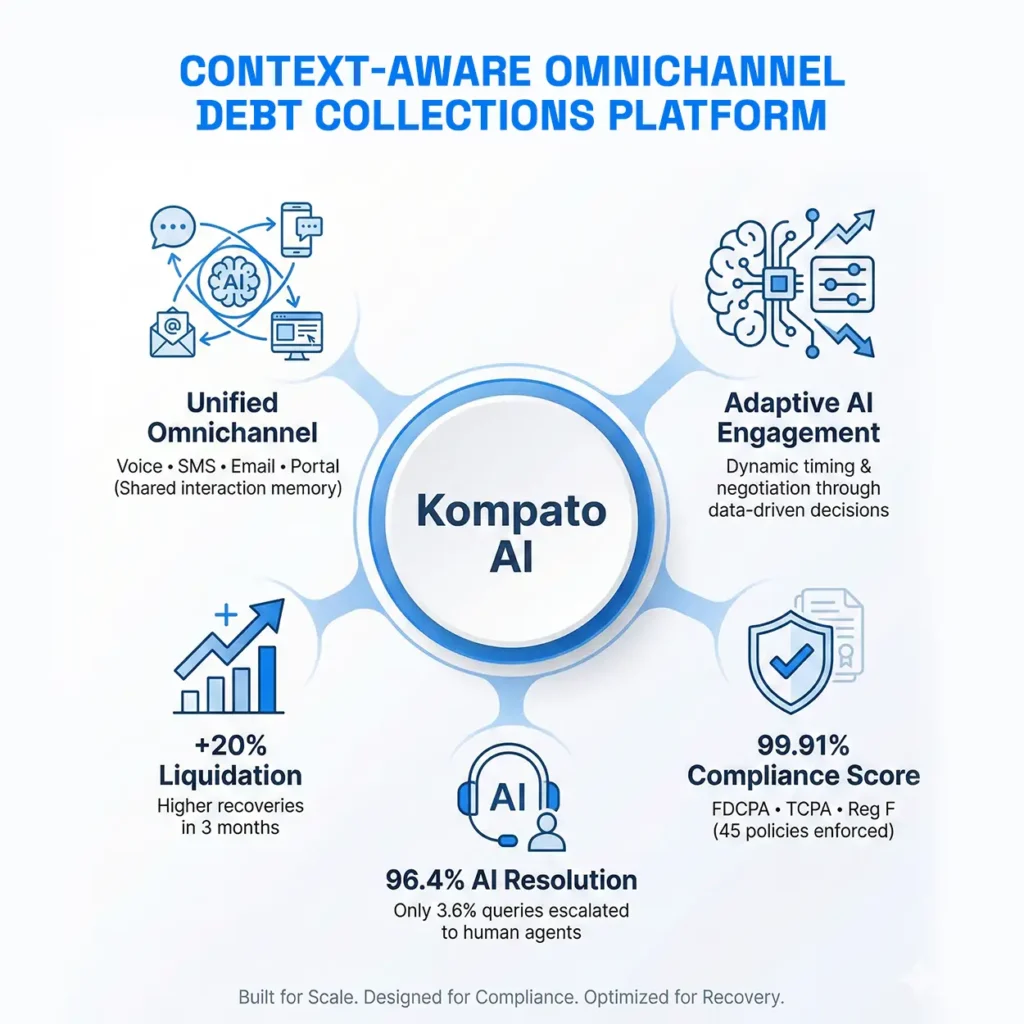
The operational principles we discussed above for omnichannel communication strategy are exactly what Kompato was designed to deliver: coordinated, persistent, compliant outreach across voice, SMS, email, and portal with a unified memory of every consumer interaction. We deliver on what the market demands today and in the future!
The difference between AI and traditional debt collection methods becomes clear in execution. Kompato AI recognizes what traditional tools miss. Not all accounts need the same approach. Some consumers need time and structure. Others just need an easy way to resolve. Leveraging AI capabilities, Kompato’s AI adapts outreach, timing, and negotiation paths dynamically based on data-driven insights. So pressure isn’t wasted where empathy works better, and opportunity isn’t lost where speed matters more.
- We’ve driven liquidation rates 20% higher than those of peer agencies within three months.
- All regulatory requirements(FDCPA, TCPA, and Regulation F) are hard-coded in our system and enforced in real time across all interactions and touchpoints. Our compliance report shows 99.91% pass rate across 45 regulatory and internal policies.
- Kompato powers AI phone calls with real-time scoring and adaptive negotiation with profitability guardrails and compliance. Plus, our two-way AI-powered texting and email are coordinated intelligently at the right time across the right channels.
- Our AI agents resolve 96.4% of queries, leaving only 3.6% of live voice calls escalated to human agents.
Final Thoughts
Omnichannel communication strategy isn’t about how many channels you have; it’s about whether those channels share memory, coordinate timing, and compound each other’s effectiveness. Most organizations are multi-channel, not omnichannel, and the gap between the two is not technology; it’s orchestration and integration discipline. The operations that invest in coordination, attribution, and adherence today will compound those advantages as AI-driven orchestration matures.
With smaller teams, tighter regulations, and higher expectations, Kompato helps debt collections operate with clarity instead of chaos. It doesn’t add more noise. It makes every interaction count.
If fragmented outreach, rising costs, or compliance risk sound familiar, it may be time for a different approach. Book a meeting and see how Kompato helps!