

Ideally, the debt collection process should start with a simple outreach and end with a successful recovery. However, in reality, collection agencies are only able to recover 20-30% of unpaid debts on average. In the real world, many bad debt recovery strategies hinder the debt collection process, including using outdated customer data, poor outreach timings, one-size-fits-all strategies, lack of empathy towards consumer financial situations, poor adherence to compliance restrictions, and inefficient outreach.
Jim Barbaresso once said, “Data is the new currency of the digital age. Leveraging this data, in 2026, the debt collection industry can recover more or less. Less time, less effort, and less compliance risks through the power of AI and data-driven strategies that eliminate the guesswork.
As a modern, AI-driven debt collection company, in this article, we discuss successful debt collection techniques that work in 2026, drawn from our hands-on experience and continuous learning.
Leverage Data & Analytics from Day One
In 2026, one of the most successful debt collection techniques is to replace intuition with evidence, and that comes from data-driven insights. Rather than treating all accounts in the same way, successful debt collectors and lenders establish a clear analytical foundation through AI. Predictive analytics techniques score accounts based on the likelihood of payment by considering multiple factors like the debtor’s payment history, age, relations, current financial situation, sentiments, and compliance terms.
Interestingly, 90% of finance companies and 80% of retail companies are already using AI for decision-making.
Early use of data analytics enables debtors and lenders to tailor their outreach strategies intelligently by selecting the right channel, right time, right message, and applying the appropriate level of empathy before costs escalate or compliance risk increases.
Financial institutions can go a step further and use this collection strategy to track KPIs in real time, including liquidation rate, cost per dollar recovered, right-party contact probability, and time-to-resolution.
Compliance-as-Code
Compliance is not just a regulatory requirement but one of the successful debt recovery strategies. How? AI learns the evolving compliance rules automatically, including FDCPA, TCPA, Regulation F, and state-specific rules, and applies them in real-time across every interaction to reduce human error, customer complaints, and compliance violations.
As a result, financial organizations like banks, debt buyers, and lenders maintain customer trust while adhering to compliance regulations, and that leads to higher recovery rates.
Kompato AI’s monthly internal compliance monitoring shows 99.91% pass rate across 45 regulatory and internal policies.
Contact Delinquent Accounts Early & Consistently
According to NBC News, in Q4 2024 alone, U.S. credit card balances jumped by $45 billion, reaching $1.21 trillion, the highest level on record. This emphasizes the importance of avoiding bad debt recovery practices, and determining the right collection strategy to recover the amounts.
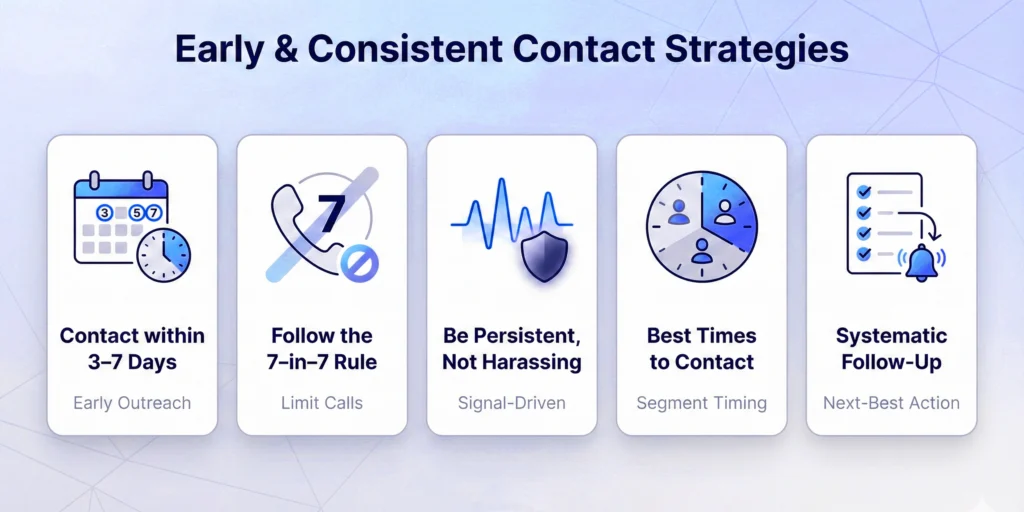
Contact within 3-7 days of delinquency
For lenders such as credit card companies or consumer finance providers, the first week after delinquency has the most critical pre-charge-off recovery window. That’s why we recommend reaching out to the consumer within 3–7 days, while adhering to compliance requirements, to minimize losses after charge-off and before escalation to third-party collections.
Follow the 7-in-7 rule.
Post charge-off, CFPB Regulation F limits debt collectors’ contact to no more than seven phone calls in seven days per consumer. Also, a seven-day waiting period is mandatory after a phone conversation. The goal is to give customers a break and prevent harassment and frustration for maximum recovery while maintaining long-term relationships.
Be persistent but not harassing.
Persistence must adapt intelligently based on signals, not timers. To give you a few tips:
- If you connect with the Right Party Contact (RPC), increase contact intensity.
- If you face repeated hangups, reduce call attempts and switch to another channel.
- In case of digital engagement without payment, target follow-ups.
Persistence must adapt intelligently based on signals, not timers. To give you a few tips:
- If you connect with the Right Party Contact (RPC), increase contact intensity.
- If you face repeated hangups, reduce call attempts and switch to another channel.
- In case of digital engagement without payment, target follow-ups.
However, manual follow-up inevitably drifts, and consistency collapses under volume spikes. A better collection strategy is to leverage AI tools like Kompato AI to manage this process through intelligent automation with a human in the loop.
Best times to contact different debtor segments
The best time to call a consumer varies by account state, not demographics alone. From our own experience, we’ll strongly recommend that you segment timing by:
- New vs aged delinquency
- Balance size
- Prior interaction history
- Channel responsiveness
- Emphasize learning loops
An interesting fact we’ve observed is that teams saw higher RPC rates by clustering calls around each debtor’s historical answer windows instead of generic best hours.
Systematic follow-up schedule
Humans can’t maintain perfect cadence across thousands of accounts. Utilize AI to make this process efficient by dynamically scheduling the next best action for every account, instead of maintaining static calendars.
Adapt Multi-Channel Communication for a Successful Debt Collection Strategy
Those executing an omnichannel digital strategy are seeing payment arrangements increase by 40%, and the cost to collect being cut by 50%, making it one of the most successful debt collection methods.
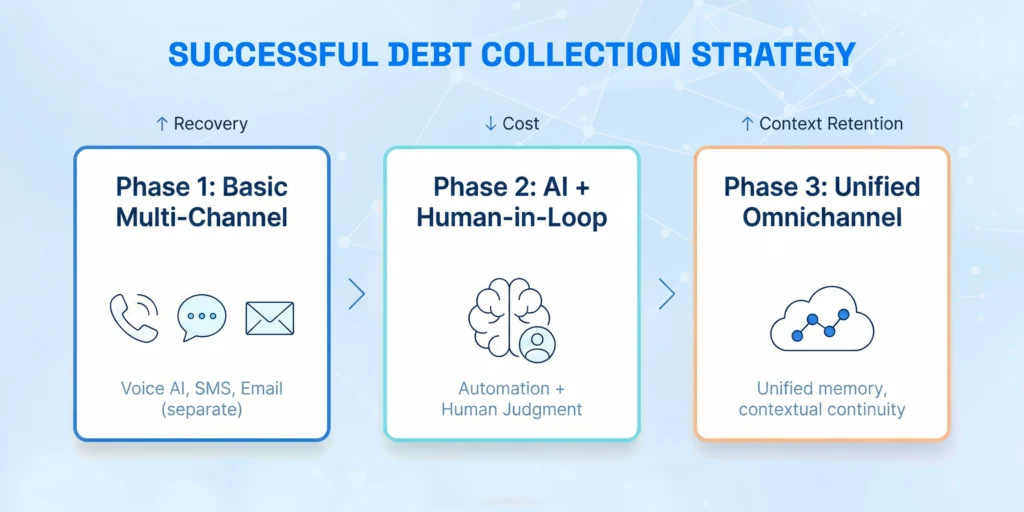
However, omnichannel is a phased capability that requires operational maturity and data readiness, not immediate transformation. That’s why we suggest financial organizations roll out this strategy incrementally, where each phase leads to higher recovery metrics (e.g., liquidation rate, cost efficiency) than current operations.
- Phase 1: Build basic operations with multi-channels (voice AI, SMS, and email) separately to reach baseline performance.
- Phase 2: Combine AI with a human in the loop, where AI handles automation (responding to low-complexity cases), and humans handle judgment and empathy. Additionally, assign separate phone numbers to each channel to track which channel drove the contact to measure the right channel, right time.
- Phase 3: Optimize phase 2 by implementing an AI-powered omnichannel communication strategy that requires unified memory to preserve context from previous interactions across all channels (voice, SMS, email, letters).
Engage with Empathy and a Personalized Approach: An Underrated Debt Collection Strategy
According to psychology, consumers respond better to empathetic, context-aware communication instead of robotic conversations. Many financial institutions utilize chatbots that give scripted responses without context, which feels robotic even if the language is natural. A better approach that we suggest is to leverage AI with context awareness (through unified memory) and acknowledge emotions (through sentiment analysis) in real time.
That’s why Kompato’s design philosophy revolves around “Human-Centric AI & Fusion with Humans” to assist human agents rather than replacing them.
Recognize Emotional States:
Research in social psychology shows that positive interpersonal connections, indicated by rapport, lead to higher engagement and cooperation. One of the best practices in collections strategies is to understand customers’ emotional state and act accordingly:
- Agreeable: Signals readiness to resolve. Take payment immediately
- Defensive: Often indicates mistrust, confusion, or prior negative experience. Find small agreements, build rapport
- Apathetic: Often indicates deeper hardship. Use empathy, understand bigger issues
- Worried: Requires caution and transparency. Be cautious (call baiting risk), follow compliance
- Controlling: Responds best when given agency. Let them guide, stay interactive
Offer Flexible Payment Solutions For Effective Debt Collection
Sometimes, a previously reliable debtor is unable to pay debts not because of unwillingness but due to their current financial situation. To maintain long-term relationships, we recommend tailored payment plans such as early payment discounts, interest charges on overdue accounts, a grace period for hardships, installment plans, and temporary deferrals.
However, it’s important to consider that payment APIs may only allow pre-existing payment plans, limiting the ability to negotiate new ones. So use pre-made offers for the pilot phase when debt type and balance size allow, then track how often pre-made offers match what teams would create vs. require customization.
Contrary to the common belief, we’ve also found that sometimes consumers may repeatedly submit lower settlement offers to test system limits. To prevent abuse while maintaining flexibility, track gaming attempts (repeated submissions, declining offers) and adjust guardrails.
Learn Professional Negotiation Techniques to Avoid Bad Debt Recovery
Do Your Research Before the Call
Surprisingly, teams observed a large drop-off before consumers even heard settlement offers. So, measuring the “offer heard rate” creates an actionable target for improvement.
One of the best practices in collections strategies is to gather financial records, payment behavior, and current financial situations to enter the call with context, which is the most successful collection strategy. Preparation reduces friction, prevents repetitive questioning, and positions the conversation around resolution rather than discovery.
Start with Open-Ended Questions
Another successful debt collection technique is to ask open-ended questions. The psychology behind this approach is to reveal the debtor’s intent and gather detailed information, rather than getting “yes” or “no”.
One of the collection strategy examples is instead of asking, “Can you make a payment today?” which often triggers an automatic no. A collector might ask, “Can you walk me through what’s been affecting your ability to pay recently?”
With that context, the conversation naturally moves toward realistic solutions rather than resistance, which increases the likelihood of repayment.
Negotiate Clearly and Realistically
Successful debt collection techniques require skilled negotiators to understand when to listen, when to clarify, and when to anchor the discussion around realistic commitments rather than demands.
Successful negotiation techniques reframe repayment as a manageable solution by breaking larger balances into achievable steps, and securing incremental agreements that build momentum while observing real-time context, prior promises, payment capacity signals, and emotional cues.
At Kompato, our AI tools perform automated quality review (for language, tone, compliance rules) and deterministically provide consistent coverage across 100% of interactions.
Structured Objection-Handling Framework
Teams observed large drop-offs before consumers even heard the settlement offer. It’s important to make objection-handling measurable and tunable (turns, transfer rules), and explicitly address drop-off before the offer. For this, we recommend a few steps during the interaction:
- Step 1: Validate the consumer’s feelings – When people feel heard, they are more willing to engage.
- Step 2: Once emotions are stabilized, the collector reframes the call as a problem-solving exercise rather than an enforcement action.
- Step 3: Tell them what you CAN do (focus on solutions). For example, instead of emphasizing constraints or policy limits, redirect the conversation to actionable options like installment plans, timelines, or next steps.
Handle Common Objections by Category
- Circumstantial: Consumers might be facing temporary hardship, such as job loss or medical issues. Respond with empathy and suitable payment plans.
- Emotion: Caused by anger, likely stemming from a prior negative experience. Acknowledge emotions and then refocus on solutions.
- Intellectual: Uncertainty about balances, dates, or legitimacy. Provide clear explanations and simplified next steps.
- Criminal: No intent to pay. Repeated broken promises. Required early escalation and controlled engagement.
Get Commitment in Writing
To prevent future disputes and maintain a defensible compliance record, draft a formal legal letter that includes a clear statement of debt, repayment terms, consequences of non-payment, and settlement conditions.
Follow Up Consistently
Negotiation does not end at agreement. Structured, compliant, and timely follow-up reinforces accountability and prevents momentum loss. By leveraging AI, financial institutions can automate this process and contact the debtor when and where (SMS, call, portal, email) they are most likely to engage.
In a four-way Champion Challenger, Kompato’s use of these AI techniques allowed it to exceed the average of the three other agencies’ liquidation rate by 39%.
Manage Emotions (Yours and Theirs)
Experienced collectors learn to regulate their own emotional state first so they can interact calmly. Imagine a collector calls a customer who immediately says, “You people keep calling. I already told you I don’t have the money.”
Instead of responding defensively, the collector may pause and respond:
“I hear the frustration. Let’s slow this down for a moment. My goal isn’t to pressure you, it’s to understand what’s realistically possible right now.”
And the conversation naturally leads to a realistic solution because of the regulated emotions.
Balance Collections with Customer Relationship Preservation
Aggressive techniques create a false sense of urgency and lead to bad debt recovery. What we mean is that debt buyers may recover the amount today, but at the cost of long-term consumer relationships that introduce churn, complaints, and compliance violations.
It’s important to strike a balance by offering legitimate customer structured repayment paths, temporary relief, or installation programs to maintain consumer relations even if resolution takes longer.
Empower Your Team with the Right Tools
To boost productivity, stay competitive, save hours, and recover more, leverage automation and predictive analytics tools like Kompato AI that handle much of your work. Kompato unifies account data, engagement history, compliance rules, and next-best actions into a single operational view. Our AI-driven automation prioritizes accounts, schedules omnichannel intelligent follow-ups, and enforces regulatory limits in real time.
CRM Integration
Without CRM integration, a consumer tells their story to multiple different agents over multiple weeks, each unaware of prior conversations.
With CRM integration, the next agent opens the account and says:
“I see you spoke with us last Thursday about a temporary hardship and discussed a two-part payment. Let’s continue from there.”
As a result, you gain consumers’ trust immediately, and the time that could have been wasted on frustration is now spent on the recovery process.
Automated Workflows
Instead of spending hours on repetitive, unproductive work, in 2026, we strongly recommend automated workflows powered by AI and machine learning to streamline tasks like payment reminders, follow-ups, and handling consumers’ queries to boost efficiency and recovery rates.
According to Zipdo, AI reduces the average debt recovery time by approximately 25%.
Performance Dashboards
What gets measured gets managed, but only if it’s measured correctly. Effective dashboards go beyond simple metrics like calls made, accounts touched, and dollars collected; they surface KPIs like emotional disposition shifts, promise-to-pay breakage, channel effectiveness, offer heard rate, transfer-to-human rate, and time-to-resolution. These advanced insights help debt buyers and lenders make data-driven decisions at scale.
Why Manual Processes Can’t Scale
Labor Costs and Human Limitations
Manual labor scales costs faster than results. Imagine a retail lender where each collector manually calls around 100 accounts a day. As volumes rise, hiring increases costs immediately, and recovery barely improves because human attention, judgment, and efficiency don’t scale linearly, leading to bad debt recovery. Track defect rates (missed transfers, missing dispositions, duplicate logs) and the labor hours spent correcting them.
For a detailed comparison of how AI-powered and traditional collection models stack up, read our breakdown of AI debt collection vs traditional methods.
Research indicates that AI technologies increased collections by up to 30% and reduced collection costs by up to 40%.
Inconsistent Messaging and Compliance Risks
Imagine the same debtor receiving a hardship offer from one agent and a legal warning from another days later. It’s because humans struggle to manually retain the context due to siloed information that creates unnecessary compliance exposure.
Inability to Scale Up/Down with Demand Fluctuations
Imagine delinquency volumes spiking after an economic shock. Hiring takes weeks, training takes months, and by the time staff are ready, demand has shifted again, leaving the organization either understaffed or overbuilt.
Leverage AI in Modern Debt Collection
AI-Powered Phone Calls with Real-Time Negotiation
AI first identifies the right time, right channel, and right strategy before the call, targeting maximum recovery rates. During the call, AI listens, analyzes current financial citations, and proposes a tailored strategy based on multiple factors we’ve discussed earlier. Or AI can also escalate to human agents if complexity increases.
Two-Way AI Texting and Email
To save time and human resources, financial institutions should switch to conversational AI (built on prior context) at scale to handle replies, answer questions, and escalate only when human judgment is required.
Currently, Kompato’s AI agents resolve 96% of queries, and only 3.6% of live voice calls are escalated to humans.
Automated Payment Reminders and Follow-Ups
Similarly, we recommend letting AI schedule early-stage outreach (SMS, call, portal) with a tailored plan based on likelihood to pay while avoiding over-contact risk.
Real-Time Scoring and Adaptive Strategies
Unlike humans, AI can continuously rescore accounts in real time as behavior changes. As a result, strategies adjust immediately as channels shift, offers evolve, plans change, and human intervention is triggered only when required.
To understand how these AI capabilities will evolve over the next two years, read our forecast on the future of AI in debt collection.
Benefits of Technology-Driven Collections
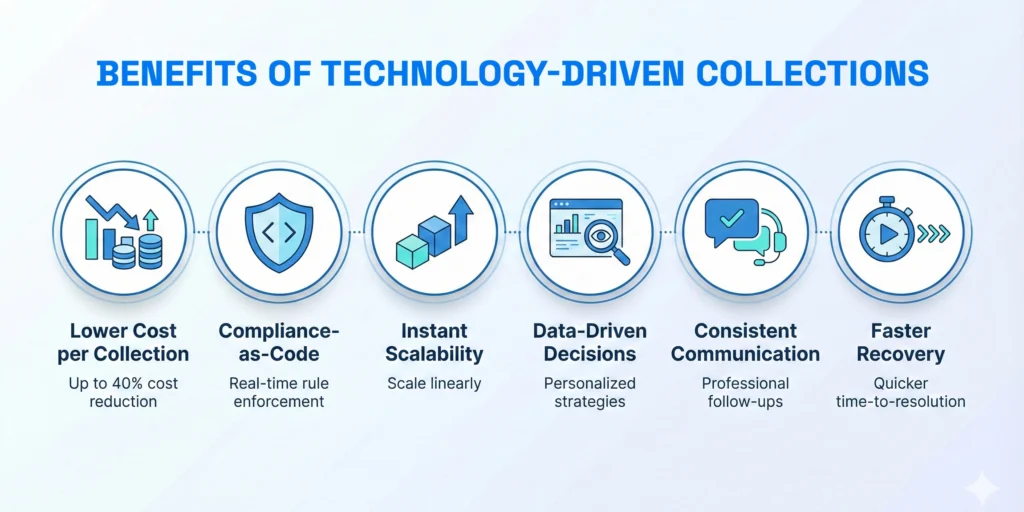
Lower Cost per Collection
According to McKinsey, organizations leveraging AI in collections can reduce operational costs by up to 40% and increase recoveries by 10%, which makes AI integration an incredibly successful debt collection technique.
Compliance-as-Code
When compliance rules (FDCPA, UDAAP, state-specific rules) are embedded in code, they are implemented automatically in real time, which reduces compliance risk and complaints caused by human error.
Instant Scalability
Unlike human resources, technology scales linearly as delinquency spikes or downturns. Hence, no hiring delays or quality degradation.
At Kompato, we have scaled from 10K to 1M+ accounts in 45 days.
Data-Driven Decision Making
When decisions are made on facts, not assumptions, financial institutions can approach personalized strategies instead of one size fits all solution. We’ve seen that it improves recovery rates, increases operational efficiency, and enhances customer experience.
Consistent, Professional Communication
Unlike human agents that have the potential to be forgetful, automated software is programmed for intelligent follow-ups with personalized communication to stay consistent while adhering to compliance rules.
Kompato: The First Nationwide AI Collections Agency
Kompato is the first and only nationwide licensed AI Collections Agency in the USA and vendor of its recovery tech for debt buyers, lenders, creditors, and banks. On top of that, at Kompato our AI tools combine the power of AI, ethics, compliance (FDCPA, TCPA, and UDAAPs), and automation into a single platform for maximum recovery rates.
We’ve driven liquidation rates 20% higher than those of peer agencies within three months. Less than 1% of those conversations are escalated to a human agent.
For collection managers, banks, debt buyers, B2B companies, and lenders, Kompato AI offers multiple features like AI-powered phone calls (that adjust tone, offers, and escalation path in real-time) with live scoring. Our intelligent omnichannel feature with unified memory ensures consumers are contacted at the right time, right channel, with the right strategy while remaining fully compliant. Kompato’s payment portal completes the loop by presenting dynamic, AI-driven offers based on intent, affordability, and risk, allowing consumers to self-resolve without friction.
Ready to transform your debt collection strategy with AI? See how Kompato can reduce costs while improving recovery rates. Schedule a demo today!
Final Thoughts on Successful Debt Collection Techniques
Successful debt recovery today requires more than applying time-tested tactics; it demands the ability to execute with speed, consistency, and precision at scale. This is only possible with AI-driven technologies in debt collection. In 2026, financial institutions that combine proven collection principles with AI-powered execution will recover more, spend less, stay compliant, and protect long-term customer value.
Discover how Kompato’s AI-powered collections can maximize your recovery rates—schedule your personalized demo.
Frequently Asked Questions
The 7-7-7 rule limits outreach to no more than seven calls within seven days, across no more than seven consecutive weeks for a single account. This debt collection strategy aims to prevent harassment and customer frustration for effective payment recovery while maintaining long-term customer relations.
Modern debt collection strategies combine AI with humans in a loop to analyze behavioral data, payment history, and communication preferences to personalize outreach.
The most successful debt collection strategies are based on data-driven insights, clarity, empathy, and commitment while adhering to regulatory compliance. Proven approaches include:
1. Dealing with consumers with empathy and offering realistic payment plans where applicable
2. Following up through intelligent omnichannel orchestration through the right channel, right time strategy.
3. Leverage data-driven insights and predictive analytics to handle accounts with a tailored strategy.
4. Use AI-powered automation for routine tasks and early outreach.
Yes. When implemented with explainability, governance, monitoring, and proper training, data about FCDPA, AI-driven debt collection can be FDCPA-compliant.
According to McKinsey, organizations implementing advanced AI capabilities in collections report a 40% reduction in operational costs and a 10% increase in recovery primarily by automation, predictive analytics, and increasing first-contact resolution.
You should contact a delinquent account internally for about 30-90 days, starting with friendly reminders and escalating contact before sending it to an external debt collection agency, which typically happens when an account is 90-120+ days past due, after failed attempts.
Behavioral patterns are the best way to identify his intentions. Red flags include repeated broken promises, inconsistent stories, refusal to provide basic information, and persistent avoidance across channels.